NEW Rail and Highway Transmission Planning Act Advances the Solutionary Rail Vision
Dear Friends,
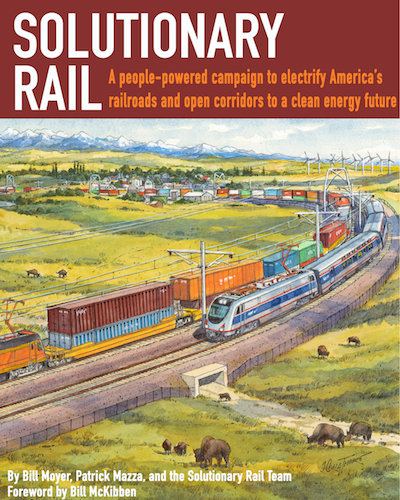
Solutionary Rail has long advocated for co-locating electric transmission on railroad rights of way in order to build a national super-grid. Our 2016 book and subsequent work has consistently pointed out that the failed reliance on private initiatives to create new, contiguous transmission corridors is folly. Maps of US wind and solar resources demonstrate the potential for abundant, affordable electricity and opportunities for rural communities, electric utilities, and tribes (not to mention railroads, industry, and the public) to benefit from use of existing rights of way.
Over the years, Solutionary Rail has advocated for federal action to describe not just the need for transmission, but also the value of such investments and the cost of failing to to so. In fall of 2024, a study from the Department of Energy's Grid Development Office did just that. It analyzed the potential savings the US could capture if transmission investments are made. That study compared three technologies:
- Conventional high voltage alternating current (HVAC) transmission, i.e. “AC” in the bar chart,
- High voltage direct current (HVDC), currently used for efficient point to point transmission, i.e. “P2P” in the bar chart, and
- Multi-terminal HVDC, i.e. "MT" in the bar chart, utilizing advanced multi-terminal converters, which results in the greatest potential benefits to consumers across the transmission options.
On Thursday, February 5, 2026 that work took another significant step forward with Congressman Kevin Mullin’s (CA-15) introduction of the Rail and Highway Transmission Planning Act. This bill takes the next steps to identify opportunities and obstacles to co-location of transmission on existing rights of way. It includes the three technologies mentioned above, as well as the potential for use of buried—in addition to above-ground—transmission.
Interview: Congress Must Act to Protect Rail Shippers from Wall Street Greed (w/ Ann Warner)
Listen and subscribe on your favorite platform: Substack, Apple Podcasts, Spotify, Youtube.
Though the railroad industry was deregulated in 1980, the public was always supposed to retain access to rail service that it could rely upon at a competitive price.
That promise has been broken, and Wall Street is only partially to blame. A lack of clarity and specificity in the statutes that authorize the Surface Transportation Board (STB) to regulate U.S. railroads has also prevented this agency from exercising the authority it is meant to have. That is why a growing base of support is coalescing around the bipartisan Reliable Rail Service Act.
Read moreInterview: Captive Shippers and Their Fight for Reasonable and Reliable Rail Service (w/ Emily Regis)
Listen and subscribe on your favorite platform: Substack, Apple Podcasts, Spotify, Youtube.
We recently released Episode Four of our main Reconnect America series. It explores in depth the story of the unique U.S. experiment in private ownership of the critical national infrastructure that railroads constitute, and the concessions we have made over the course of a century and a half to sustain that system. If you haven’t listened to it yet, we highly recommend you check it out.
As we prepare to continue the story into the present day with Episode Five, we are exploring the experiences of shippers who depend on railroads to move their products, by speaking with some of the folks who represent these businesses in negotiations with railroads and before the Surface Transportation Board (STB).
Read moreEpisode 4. Private Railroads for Public Purpose: Battles, Misadventures, and Extraordinary Measures (Part 1)
Listen/Subscribe on: Apple Podcasts, Substack, Spotify, YouTube, or watch this page for New Episodes
Rail systems around the world are mostly owned and operated by the public. But the U.S. has only ever flirted with public ownership, and mostly in moments where this seemed like the only way to preserve a functional railroad system. Instead, for almost a century, we pursued a model of regulating corporate railroads to fulfill their public purpose while sustaining the revenue needed to keep them afloat. Meeting both of these objectives proved to be a balancing act which took decades to achieve, by which time it was already coming undone, thanks to massive public investments in competing modes of transportation. While it lasted, however, this system fueled the rise of what was, at the time, the largest middle class ever known.
Read moreInterview: U.S. Railroads' Endgame Moment (w/ Byron Porter)
Listen and subscribe on your favorite platform: Substack, Apple Podcasts, Spotify, Youtube.
Wow, we interact with a lot of activists and advocates. What’s fascinating about this conversation is that amongst all of our guests thus far—Byron Porter is uniquely industry-adjacent. He brings together history, regulatory knowledge, and experience as a rail shipper and equipment provider for the railroad industry. You are gonna learn a ton from this incredible conversation—and that knowledge is gonna be very useful in the coming Endgame fight over the biggest rail merger in history.
Read moreInterview: Why Railroad Workers Are Fighting the Proposed UP-NS Merger (w/ Ron Kaminkow)
Listen and subscribe on your favorite platform: Substack, Apple Podcasts, Spotify, Youtube.
In the coming year or so, the Surface Transportation Board will determine whether to approve or block Union Pacific’s $85-billion acquisition of Norfolk Southern. This signals an attempt by Wall Street to squeeze yet more from this critical infrastructure in order to maximize returns for shareholders.
Read moreInterview: Taking on Wall Street—and its Railroads (w/ Former Congressman Peter DeFazio)
Listen and subscribe on your favorite platform: Substack, Apple Podcasts, Spotify, Youtube.
I hope you'll take some time this Labor Day weekend to listen to my conversation with former Congressman Peter DeFazio, aka Tiger of the House (an honorific and comparison with the great Oregon Senator Wayne Morse, the Tiger of the Senate).
Read moreInterview: A Labor Leader's Take on Railroad Mega-Merger, Cross-modal Solidarity, New Legislation, and More (w/ Greg Regan)
Greg Regan is president of the Transportation Trades Department (TTD) of the AFL-CIO. He has been an outspoken advocate in defense of workers and shippers over the last several years, as Class I railroads have made deeps cuts to both their workforce and the quality and reliability of their service in pursuit of stock buybacks and dividends for predatory “activist investors.”
Read moreInterview: How to Fix the U.S. Railroad Problem—and the Country (w/ Phillip Longman)
Phillip Longman is Senior Editor at Washington Monthly and Policy Director at the Open Markets Institute. He has also written for publications like Foreign Affairs, the Atlantic, and the New York Times Magazine.
Read moreInterview: History of U.S. Antimonopoly Law (w/ Basel Musharbash)
Basel Musharbash is principal attorney at Antimonopoly Counsel, where he practices antimonopoly and trade regulation law. By taking on corporate power, his work on behalf of farmers, small businesses, and workers seeks to secure the conditions for small-town economies to thrive.
Read more