The proposed acquisition of Norfolk Southern (NS) by Union Pacific (UP) is an endgame move by Wall Street to begin a final round of value extraction from critical national infrastructure. This step toward further monopolization comes precisely when we most need to reclaim the public purpose and potential of America’s national rail system: to reconnect our communities, invigorate local economies and domestic industry, and support efficient, sustainable transportation for freight and people.
The public needs rail service that is robust, resilient, and clean. That means rationalizing the balance of freight between road and rail and getting long-haul trucks off our highways; dedicated passenger capacity, honoring the bargain struck when the railroads were relieved of their passenger obligations through the creation of Amtrak; the return of service, for both passengers and freight, to the rural and urban places that have lost it; and electrification of motive power, the global standard.
The proposed merger threatens to deepen a crisis that has been building for decades and to further postpone addressing it. But this proceeding also gives the Surface Transportation Board (the Board) an opportunity, and the impetus, to tell Wall Street, the rail carriers, Congress, and the American people that a new paradigm is truly needed to put our national rail system back on track.
This merger is not about increasing intermodal or intramodal competition. We wish it were about lowering rates, improving service, and moving more traffic from truck to rail, but it is not that either.
Nothing in the current makeup of UP, NS, or any other Class I railroad prevents them from pursuing a greater share of the freight market today. What does prevent it is this: through a decades-old failure of national transportation policy, the United States has allowed the public purpose of its rail network to be hijacked by the insatiable appetite of predatory capital for ever more shareholder value. And so they merge.
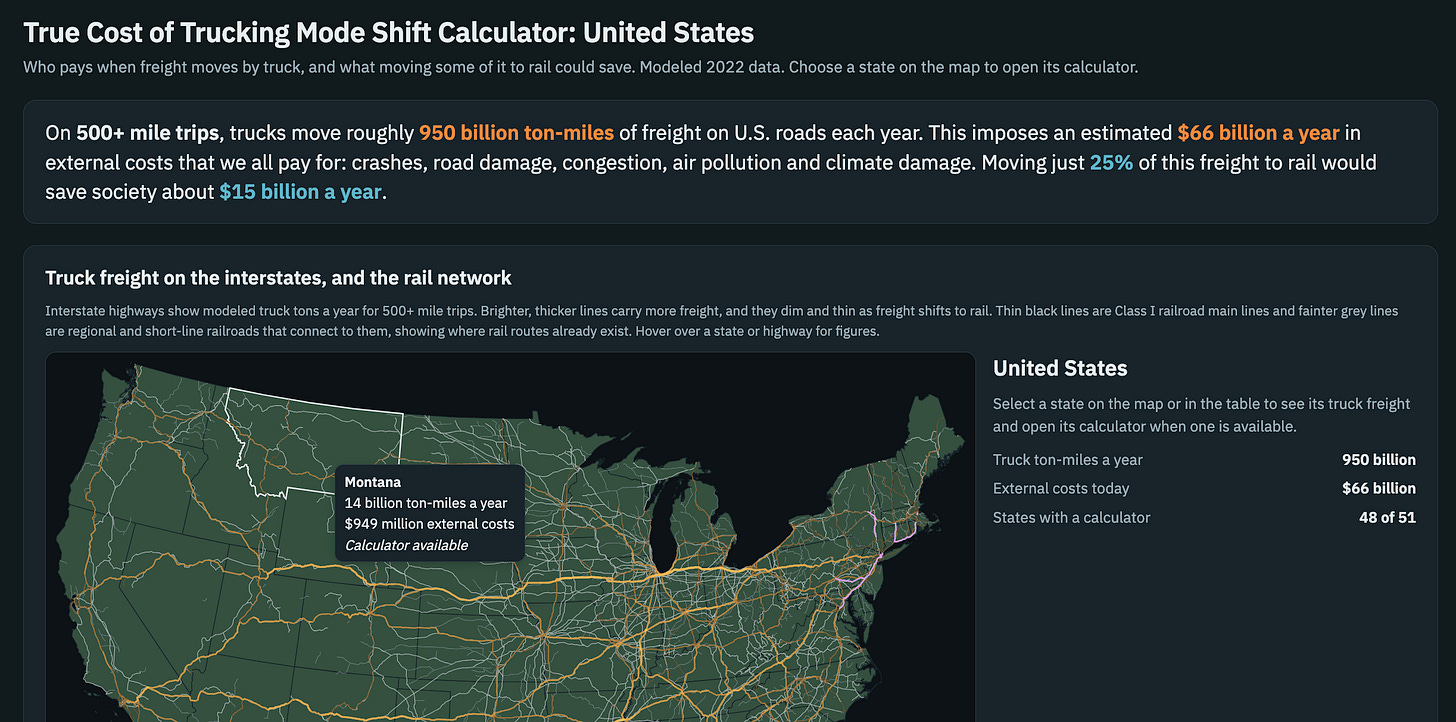
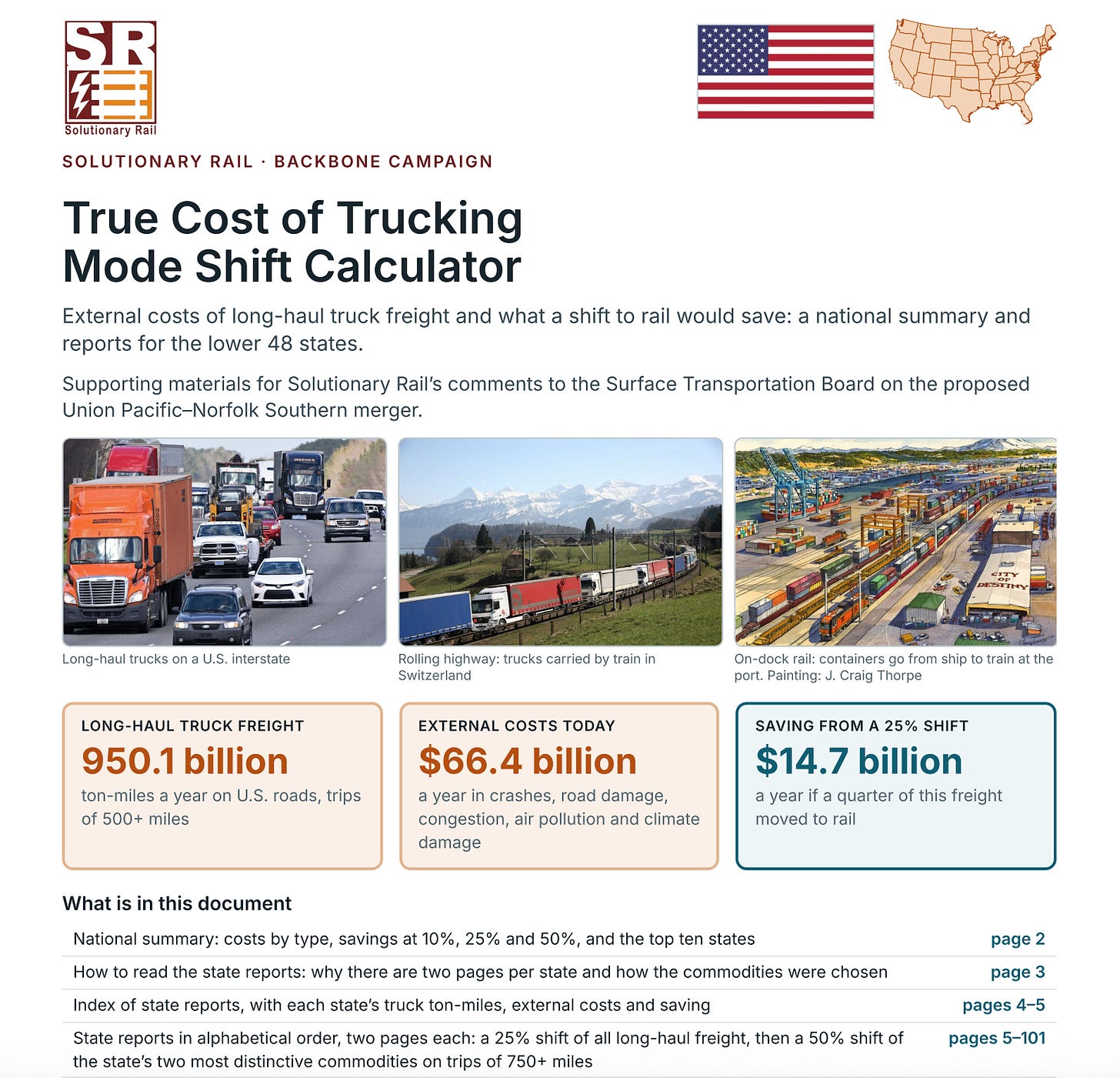
Ever since we abandoned the common carrier principle of non-discrimination, railroads have turned away and actively demarketed less profitable shippers. Today, roughly a trillion ton-miles of long-haul freight (trips over 500 miles) crowd our public roads each year, imposing an estimated $59 billion in avoidable external costs: the net savings to the public if that freight moved back to rail.
UP, NS, and the other Class I railroads have been able to push less profitable freight onto trucks while raising rates above inflation for two decades for one reason: earlier consolidations had already left rail-to-rail competition largely defunct, and no reassertion of the public purpose of this critical infrastructure checked that consolidation wave. When monopoly power lets a railroad extract extraordinary short-term profits, it has no incentive to pursue long-term growth.
The way the Class Is have used their market power shows not only that a merger is unnecessary for growing modal share, but that Board approval would simply enable a counterproductive trajectory. Regardless of whether it created operating and administrative efficiencies, the savings would not be passed on to shippers or otherwise invested in long-term growth, because the Class I railroads are no longer in the long-term growth business.
The Board’s own merger policy points to the same conclusion. Under 49 C.F.R. § 1180.1(a), the Board “does not favor consolidations that reduce the transportation alternatives available to shippers unless there are substantial and demonstrable public benefits to the transaction that cannot otherwise be achieved.” Section 1180.1(c) directs the Board to consider “whether the benefits claimed by applicants could be realized by means other than the proposed consolidation.”
The benefits the applicants promise are moving freight from truck to rail, better service, and more efficient operations. Either railroad could pursue every one of them today by reinvesting in capacity, crews, and customer service instead of stock buybacks. None of them requires eliminating one of the nation’s six remaining Class I railroads.
The external costs of long-haul trucking belong at the center of that inquiry. Solutionary Rail’s True Cost of Trucking Mode Shift Calculator documents, nationally and state by state, the pavement damage, congestion, crashes, air pollution, and carbon emissions that long-haul truck freight imposes on the public.
Those costs are, in effect, a public subsidy for the railroads’ business model of making more by doing less. Every shipment a railroad turns away or de-markets onto the highway is carried at the public’s expense, while the savings accrue to shareholders. The Board’s public interest standard requires it to weigh environmental safeguards, efficiency, and adequate service (49 C.F.R. § 1180.1(b)).
The applicants claim the merger will remove more than two million truckloads a year from the highways. Even on long hauls, that is a small fraction of the roughly one trillion ton-miles documented in Exhibit A. And the claim deserves skepticism, coming as it does from the very railroads that pushed much of that freight onto trucks in the first place.
Winning it back requires a level of service, capacity, and investment that no merger promises, and that only an industry-wide intervention can deliver. We ask the Board to weigh these external costs in judging the public benefits the applicants claim, and to recognize that the merger offers no credible plan to reduce them.
The return to merging smacks of desperation. At various points from 1920 to 2000, mergers were actively encouraged as a way to rescue struggling railroads. They were acceptable because dozens of Class I railroads (in 1920, more than 170) would go on competing after any given pair merged, and because a strong regulatory regime still held monopoly abuses in check.
None of these conditions holds today. Class I railroads are earning record profits, little competition remains among them, and the Board finds itself blocked at nearly every turn when it tries to protect shippers from the railroads’ market power.
When the Board adopted its 2001 merger rules, setting the bar so high that many considered it nearly impossible to clear, it slammed on the emergency brake, sensing it had acted too late. It knew those rules would eventually force a reckoning and, we had hoped, a national conversation about what we need from this infrastructure.
That was the moment to re-examine the Staggers Act, the abandonment of common carrier obligations, and the service exemptions, and to launch a national effort to harmonize road and rail, using the best attributes of each mode for maximum public benefit and least harm. Instead, the federal government more or less washed its hands and invited a free-for-all.
This pivot of purpose, from growth through service to profit maximization through market control, was in some sense inevitable once deregulation and consolidation had run their course, leaving the United States with just seven Class I railroads by 2000. Each held monopolistic or duopolistic control over a vast swath of the country, with no effective regulatory mechanism safeguarding shippers’ ability to access this critical infrastructure on reasonable terms.
Predatory capital, in the form of activist investors, accelerated the shift and compounded its effects. To the extent that Class I railroad managers still harbored a sense of responsibility for the long-term health and resilience of their railroads, these investors disabused them of it, threatening CEOs’ jobs and replacing those who resisted. They imposed practices aimed at making more by doing less: raising rates, de-marketing less profitable freight, tearing up track, cutting headcount, and skimping on safety.
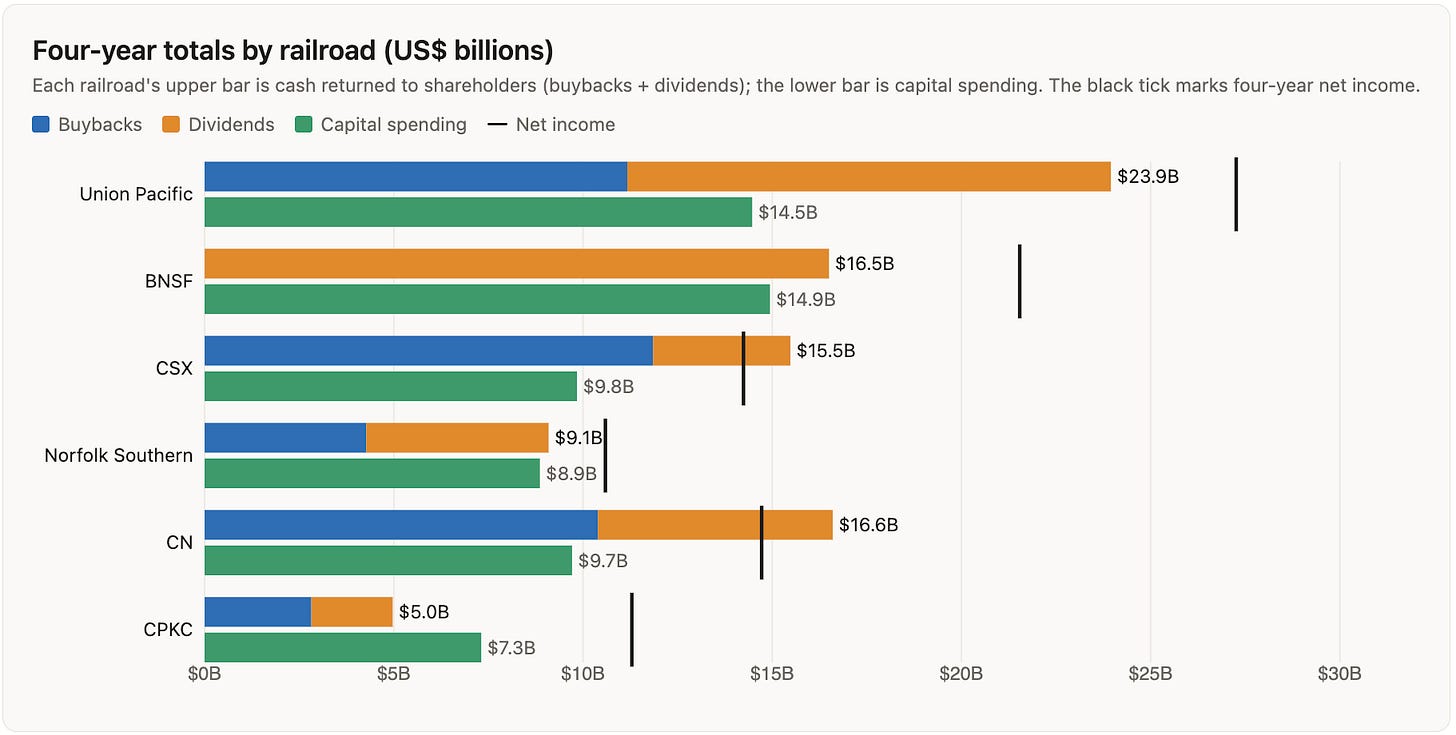
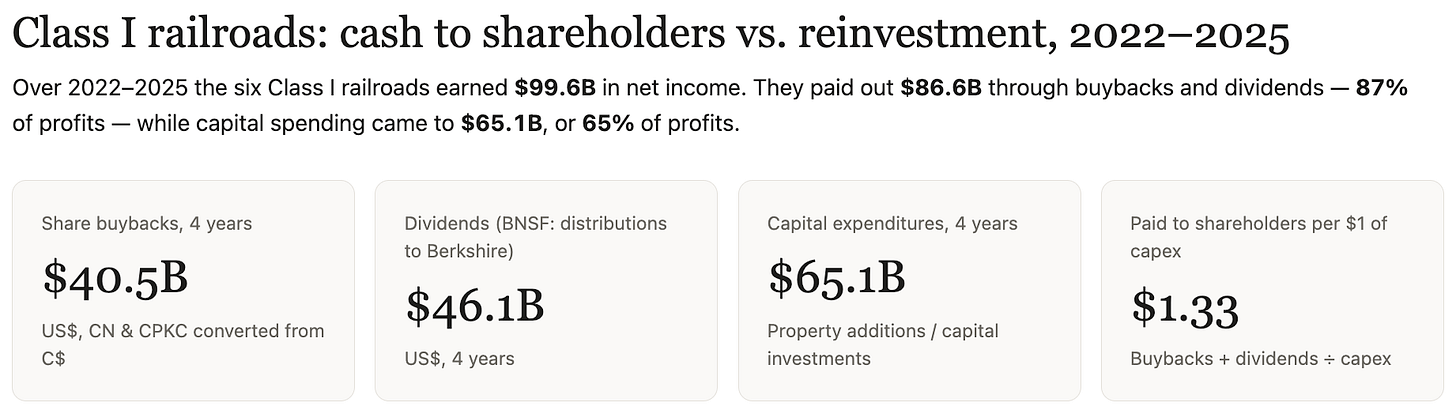
Of the hundreds of billions of dollars this regime generated, more left the system through stock buybacks and dividends than was reinvested in the railroads themselves. This continues to be the case. In every year from 2022 through 2025, Union Pacific spent more on stock buybacks and dividends than on capital investment: $24.0 billion paid out to shareholders against $14.5 billion in capital expenditures, equal to 88 percent of its $27.3 billion in net income over those four years. In 2022 alone, UP paid shareholders $9.4 billion, 135 percent of that year’s net income, and CSX and Norfolk Southern each paid out roughly a third more than they earned.
These predatory financial forces are not only the would-be beneficiaries of the merger now before the Board; directly or indirectly, they are its instigators.
The timing can be explained in part by the exhaustion of existing means for accelerating returns to shareholders. For several years, shippers have shown a waning ability to absorb further rate increases.
Then a string of crises exposed an industry that had done everything in its power to operate with invisibility and impunity: the supply chain and service meltdowns of 2021–2022; the threatened and ultimately quashed national rail strike of 2022, driven by extreme stress on a workforce that had been whittled down, overstretched, and mistreated; and the February 2023 derailment in East Palestine, Ohio, which brought home the true cost of greed and negligence.
Together, these moments drew renewed public attention to our rail infrastructure, and to the failure of the companies that control it to steward it in the public and national interest. At its 2024 hearing on growth in the freight rail industry, the Board itself called for a pivot to growth, but the tools available to it have proven inadequate to bring one about. In short, the wells Wall Street has been drawing from are running dry.
The clearest sign that financial players want to return to the old playbook of consolidation came in September 2025, when CSX replaced CEO Joe Hinrichs after sustained pressure from the activist investor Ancora, which had faulted him for, among other things, failing to pursue a merger.
UP CEO Jim Vena has hinted at openness to industry-wide reciprocal switching, sharing track without a regulatory mandate or a shipper complaint. That would be new, and it raises questions the merger application does not answer. Under what rules would it occur, and with what protections? Which operators could compete, and for which commodities? How would it resemble or differ from an open-access system?
Whether or not Mr. Vena intends it, the idea points toward a paradigm shift in how U.S. railroads operate and in the social contract they hold with the public. Yet even as the head of the nation’s largest railroad, he is constrained by activist investors. Any move that raised costs or worsened his operating ratio would be shut down, so the levers he can pull are few, and a merger is the one that lets him act on a national scale. These CEOs are far less empowered than they appear.
Intended or not, his move has opened a national conversation broader than the industry is comfortable with, and the energy behind that conversation shows the appetite for it. But the questions it raises exceed the scope and capacity of this Board. They call for congressional leadership and action, including clearer direction for the Board. The national rail network as the Board itself refers to it, is, as demonstrated in our filing, a solution hiding in plain sight. How to harness it deserves all of our attention, so that the change we get is the change we need.
The Board’s public process is meant to invite open comment, but fear of retaliation undermines frank public discussion. The recent video of Mr. Vena threatening rate increases for opponents of this merger is only the latest instance. The threat is not new, and it is not unique to Mr. Vena.
In January 2025, then-Chairman Robert Primus issued a statement opposing railroad retaliation, noting that it can take the form of “actual or threatened increases in rail transportation rates, cutbacks in local service, and refusals to provide new service upon request.” He proposed a policy statement on intimidation and retaliation, but the Board never adopted it; after the Vena video became public, he observed that had it been adopted, “there would be no hand-wringing today.”
Ann Warner of the National Industrial Transportation League has repeatedly raised retaliation and urged Congress to protect shippers. Solutionary Rail agrees, and believes those protections must extend to short line railroads, which depend on their Class I connections and are just as exposed. Many shippers who depend on a single railroad cannot afford to say publicly what they say privately.
Consolidation in the U.S. railroad industry is a one-way street with a dead end. No new long-distance main line has been built in more than a century. Each merger makes the barrier to entry for would-be Class I competitors more insurmountable, so rail-to-rail competition is a finite and ever-diminishing resource. In adopting its 2001 rules, the Board recognized that this resource was already severely depleted.
Rail-to-rail competition remains central to the Board’s 2001 rules, and what little of it remains should be guarded zealously. But genuine rail-to-rail competition would require opening the tracks to the railroads that actually want to compete. Chief among them are the nation’s more than 600 short line railroads, the retail railroads of the network, many of which want to grow but are held back by paper barriers that restrict whom they may interchange with. If the Board is serious about rail-to-rail competition, the path runs not through this merger but through working with Congress to open the network to all of its operators and to end the market control that has left this system underutilized.
Approving this transaction would sharply reduce competition on its own terms, and it would likely trigger defensive mergers by the remaining Class I railroads, exactly the kind of cumulative and crossover effects the Board’s rules require it to weigh (49 C.F.R. § 1180.1(i)). Approval would be a white-flag surrender: an admission that there is no competition left to preserve, let alone enhance, and a decision to cede our national rail system to private equity and activist investors so they can continue the slow-motion going-out-of-business sale already under way. That sale takes many forms: pushing away business, paying shareholders more than they earn, and underinvesting in infrastructure, service, and resilience, including the electrification of yards and main lines and the carload service that many shippers and communities depend on.
Making more by doing less means draining resources from critical infrastructure. Yet the nation will always need its railroads. The more value is extracted from the national rail system and the less is invested in it, the more certain it becomes that the public will once again have to intervene, as it has repeatedly: federal control during World War I, the creation of Amtrak, the creation of Conrail, and the Staggers Act itself.
Each intervention allowed the prevailing paradigm to soldier on without resolving the fundamental questions of whom this infrastructure exists to serve and what its highest purpose should be. Allowing the system to deteriorate further, so that the next intervention must rescue it from shambles, would be a costly and unnecessary delay. That is reason enough to act now.
Predatory expectations that reward and compel such self-destructive behavior will not go away of their own accord. Activist investors who have reaped unprecedented profits from the dysfunction of recent years remain hooked. They will not detach themselves from the Class I railroads as long as opportunities for extraction continue to be tolerated by the regulators and the government entrusted with railroad stewardship. If policymakers and regulators do not protect this infrastructure for future generations, no one will.
Should the Board approve, it is this class of investors, not the American people, that would benefit, and the long-overdue reckoning over the fundamental purpose of this infrastructure would be put off again. A rejection would send a signal not only to Wall Street but to all of us: shippers, railroads, regulators, advocates, and Congress. It would say that the time has come to pivot the U.S. rail network to a new paradigm of robust, resilient, and clean service, and that everyone involved needs the tools, the rules, and the resources to make that pivot.
In rejecting this merger, the Board should signal to Congress that seeing this pivot through will require Congress to clarify and expand the Board’s role, authority, and capacity, and to join as a full partner in a paradigm shift toward an American rail renaissance.
In that spirit, we note the reforms Congress should consider. Congress should address the corrosive practice of stock buybacks, which were effectively prohibited before 1982 and have since spread across industries, rail above all, so that the managers of railroads can actually manage railroads. It should protect shippers, short line railroads and other parties from retaliation. It should account for the external costs of freight transportation in national policy.
The pending surface transportation reauthorization is the place to start. Rather than advance the earlier version of that bill, Congress should go back to the drawing board and treat reauthorization as a historic pivot: harmonizing road and rail so that each mode does what it does best, and committing dedicated funding to a moonshot mode shift of long-haul freight from trucks to trains, paired with the electrification of the railroads.
That electrification should begin with rail yards. Yards are where changes in motive power have historically begun, and they are where diesel emissions concentrate in the communities that already bear an unfair share of freight’s health burden. Shifting more freight onto rail without electrifying it would only deepen that injustice. Mode shift and electrification must go hand in hand. Senator Edward Markey’s All Aboard Act already contains provisions that would fund rail yard electrification; Congress should include them in the reauthorization.
The same bill offers a model for funding dedicated passenger track within the shared right-of-way of existing rail corridors. That is the most affordable way to deliver higher-speed passenger service, at 110 to 125 miles per hour, far cheaper than building new corridors for trains above 160 miles per hour, which cannot share right-of-way with freight. That dedicated track should be built to Class 6 or Class 7 standards and reserved for passenger trains. Heavy freight trains cause extreme wear on track, while passenger trains cause relatively little, so dedicated passenger track protects both safety and on-time performance.
Congress should also continue to advance the co-location of high-voltage transmission on existing rail corridors, a national conversation that has been growing for years. Dedicated passenger track, transmission, and electrified trains fit naturally together: the same corridors can carry people, freight, and clean power.
Finally, Congress should restore the common carrier obligation and give it meaning, by defining what adequate service upon reasonable request actually requires, as Senator Tammy Baldwin’s proposed Reliable Rail Service Act would do. It should direct the Board to review and, where warranted, revoke the commodity and service exemptions, extending that obligation to all commodities. And it should open trackage rights to other Class I railroads and to short lines hungry for business, so they can offer competitive service. Deeper reforms, such as separating infrastructure from operations to create an open-access system, deserve serious consideration.
Shippers, analysts, and elected officials have talked about revisiting the Staggers Act almost since it was signed into law in 1980. With public attention now on the predicament of America’s national rail system, this is the moment for change.
The Board should not simply reject the proposed merger of Union Pacific and Norfolk Southern. It should use this proceeding to tell Congress that the time has come for a paradigm shift in how this country approaches rail transportation: rebalancing private profit with public purpose and the national interest, and harnessing rail’s unique potential to expand public benefits and dramatically reduce the externalized costs of our current regime, by shifting long-haul freight from trucks to trains and opening dedicated capacity for passengers, as was promised long ago.
Respectfully submitted,
Bill Moyer
Executive Director, Solutionary Rail
Co-author, Solutionary Rail
Host, Reconnect America Podcast
 The following piece has been adapted from comments submitted to the Surface Transportation Board on November 18, 2026, in opposition to the proposed merger between Union Pacific and Norfolk Southern.