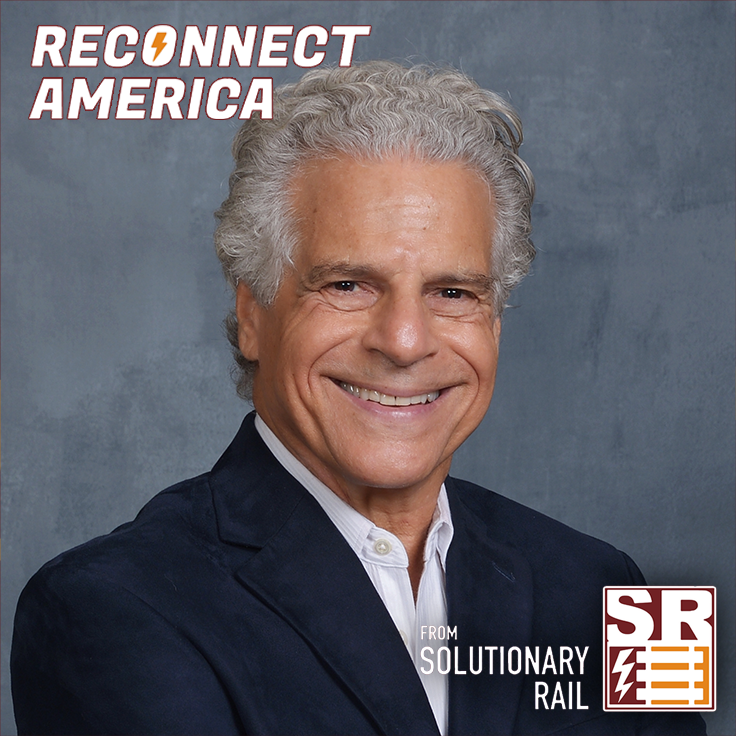
 Also like us, Michael was, and has remained committed to articulating and—most importantly—realizing a vision for a transportation system designed and operated in accordance with public interests. He understands that the energy-efficiency of rail transport must be harnessed for public benefit, not eclipsed by the Wall Street’s interest in serving only the most profitable customers in major freight hubs. And he is constantly seeking to demonstrate that what is best for the public can also be mutually beneficial for companies providing transportation services.
A few months ago, after listening to one of our Reconnect America episodes, Michael reached out to share his experience with an area of the rail industry that the episode had touched upon: short line railroads. Michael’s timing was impeccable. We were just beginning to wrap up our deep dive into the history of U.S. Class One railroads, and we were preparing to shift our attention to the parallel—but very different—world of short lines.
These smaller railroads, over 600 in number, serve as a lifeline to farmers and manufacturers in rural places across the country. Many of them came into being after 1980, when the deregulated Class Ones began spinning off and abandoning tens of thousands of miles of less-profitable branch lines. Since their inception, many of these short lines have, unsurprisingly, struggled to remain viable—despite the critical service they provide. And it was this very predicament that first inspired Michael to get involved in rail some 32 years ago.
Ever since, Michael’s company Strategic Rail Finance (SRF) has helped short lines find the resources to continue serving the communities that depend upon them. Meanwhile, his nonprofit On Track North America (ONTA) has articulated the vision behind it all. To give you just a taste of what SRF and ONTA are up to, here are their “Ten Principles of Rail Enabled Economic Development”:
-
Design for Action and Prepare to Implement
-
Radical Inclusion Amasses Synergy and Attracts Capital
-
The Right Tools Make the Right Data Actionable
-
Rail and Roads Are One System
-
Focus on Whole Supply Chains, Not Just Individual Projects
-
Railroads and Supply Chains Do Not Begin or End at State Lines
-
Smart Logistics Drives Sustainable Economic Development
-
Freight Transportation and Land-Use Planning Must Be Inseparable
-
Present Transportation Providers with a Compelling Growth Plan
-
Government Does Not Have to Fund Freight Rail Development
Solutionary Rail was founded on the principle that our “NO” is only as powerful as our “YES” is compelling. Well, I find Michael’s “YES” to be pretty compelling—compelling enough that I recently circled back up with him for another interview. The result is well worth a listen. I sincerely hope you’ll take some time this weekend to check it out.
With Gratitude & Solidarity,
Bill Moyer
Correction: in the interview, host Bill Moyer suggests that the short line holding company Genessee and Wyoming owns two short lines in Southeast Washington. The Palouse River & Coulee City Railroad (PCC) and the Great Northwest Railroad (GRNW) are in fact owned by a different holding company called Watco.
Reconnect America is hosted by Bill Moyer, co-author of the book Solutionary Rail: A People-powered Campaign to Electrify America’s Railroads and Open Corridors to a Clean Energy Future. Check out the essays and supplemental posts that complement this podcast HERE.
Help us keep the podcast ads-free and without paywalls by making a tax-deductible donation HERE.
