On August 26, DOT unveiled its America’s Great Corridors of Commerce (AGCC) initiative, “a bold initiative to fast-track colocated utility infrastructure along highway and rail corridors to address the Nation's critical energy and infrastructure needs safely and strategically.” (Watch the webinar here using the passcode “h#0I%D&H”.)
This program reflects a decade of advocacy, which has in recent years finally begun to bear fruit, including the introduction of the “Rail and Highway Transmission Planning Act” in the U.S. House of Representatives earlier this year. In early September, DOT issued a Request for Information, soliciting comments on the AGCC initiative. Click the button below to read our full comments to DOT in response to its Request for Information.
Solutionary Rail is tackling big projects and ideas. We’ve expanded our team because the work ahead is monumental. Can you pitch in to help sustain Solutionary Rail’s momentum and impact? Yourtax-deductible donations are critical. We especially need monthly donors to sustain this work—sign up for a monthly donation HERE.
The U.S. Department of Transportation’s (DOT or the Department) America’s Great Corridors of Commerce (AGCC) initiative, if implemented, would constitute a long-anticipated and highly promising breakthrough in the much-needed buildout of our national electric grid. Solutionary Rail applauds the Department’s commitment to thinking across typical administrative silos in search of opportunities to maximize private and public benefits. Accordingly, we would like to suggest a few additional areas of possible synergy to build upon important work that has already been done and dovetail with AGCC in service of public interests. Principally, AGCC could be leveraged to incentivize the electrification of U.S. railroads and a shift of freight off of roads and onto tracks to take advantage of the efficiencies and lower external costs of rail transport. Important work done in recent years across federal agencies already indicates the lines along which such a program could be structured. This work includes the Department of Energy’s Grid Deployment Office’s 2024 “National Transmission Planning Study”; the University of Texas at Austin’s Federal Railroad Administration-sponsored 2025 study “Cost and Benefit Risk Framework for Modern Railway Electrification Options”; the 2024 interagency “Action Plan for Rail Energy and Emissions Innovation”; and the 2015 Congressional Budget Office working paper “Pricing Freight Transport to Account for External Costs”.
Maximizing Opportunities through Rail Electrification
The electrification of U.S. railroads offers significant long-term cost savings and operational efficiencies for rail carriers, including the ability to move more freight more quickly and at a lower cost. However, the high upfront costs of electrification have thus far deterred U.S. rail carriers from electrifying their lines and yards. Co-location of electric transmission on rail rights-of-way (ROWs), combined with other recent developments in the state of electric propulsion and storage technology, could lower those barriers enough to make electrification an attractive option for U.S. railroads. In such a scenario, railroads would also constitute a major customer for utilities, with the potential for long-term contracts to substantially reduce uncertainty for both parties around electricity rates. This win-win opportunity was highlighted by the 2025 study “Cost and Benefit Risk Framework for Modern Railway Electrification Options”, carried out by the University of Texas at Austin under the sponsorship of the Federal Railroad Administration (FRA):
If these easements are made in conjunction with railroad electrification, both the railroads and the electric utility companies stand to gain. For the railroads:
Construction of OCS [overhead catenary system] typically involves a significant cost of building distribution lines to connect traction substations with the electricity grid. This would be mitigated if the electrical distribution network were already to be next to the electrified railway.
A new source of income helps the economics of rail electrification.
Right-of-way easement deals with utility companies can be structured to reduce the amount of uncertainty railroads see in future electricity prices.
For the electric utility companies:
Acquiring long stretches of ROW from one entity rather than hundreds of separate property owners greatly reduces the complexity of planning a new high-voltage distribution line. This reduces the risk of delays and the risk of unexpectedly high ROW costs.
Railroad rights-of-way have already been cleared of foliage and undergone significant environmental review processes.
Assisting freight railroads with electrification provides the utility companies with new industrial customers. (pp.133-34)
Elsewhere in the study, the authors support these conclusions by citing both previous studies and a successful electrification project:
In the case where electrification occurred (BC Rail), and the cases where electrification was closest to occurring (TVA or SP), the railroads were able to create partnerships with the electric utility companies. The conclusion is that railroads want assurances on electricity prices, and utilities want ROW for new transmission lines.
Multiple examples have shown that co-locating electric transmission lines with rail corridors makes rail electrification easier to implement. For example, the new transmission lines to power the mine for the Tumbler Ridge subdivision substantially lowered electrification costs, and SP found that ROW sharing could make electrification more feasible for multiple corridors. Meanwhile, the utility’s transmission lines could be built with less uncertainty over ROW procurement. The TSC study for FRA suggested ways to formalize partnerships between railroads and utilities to help spread the initial capital outlay over multiple parties to reduce debt and risk burden on the railroads. (p.40)
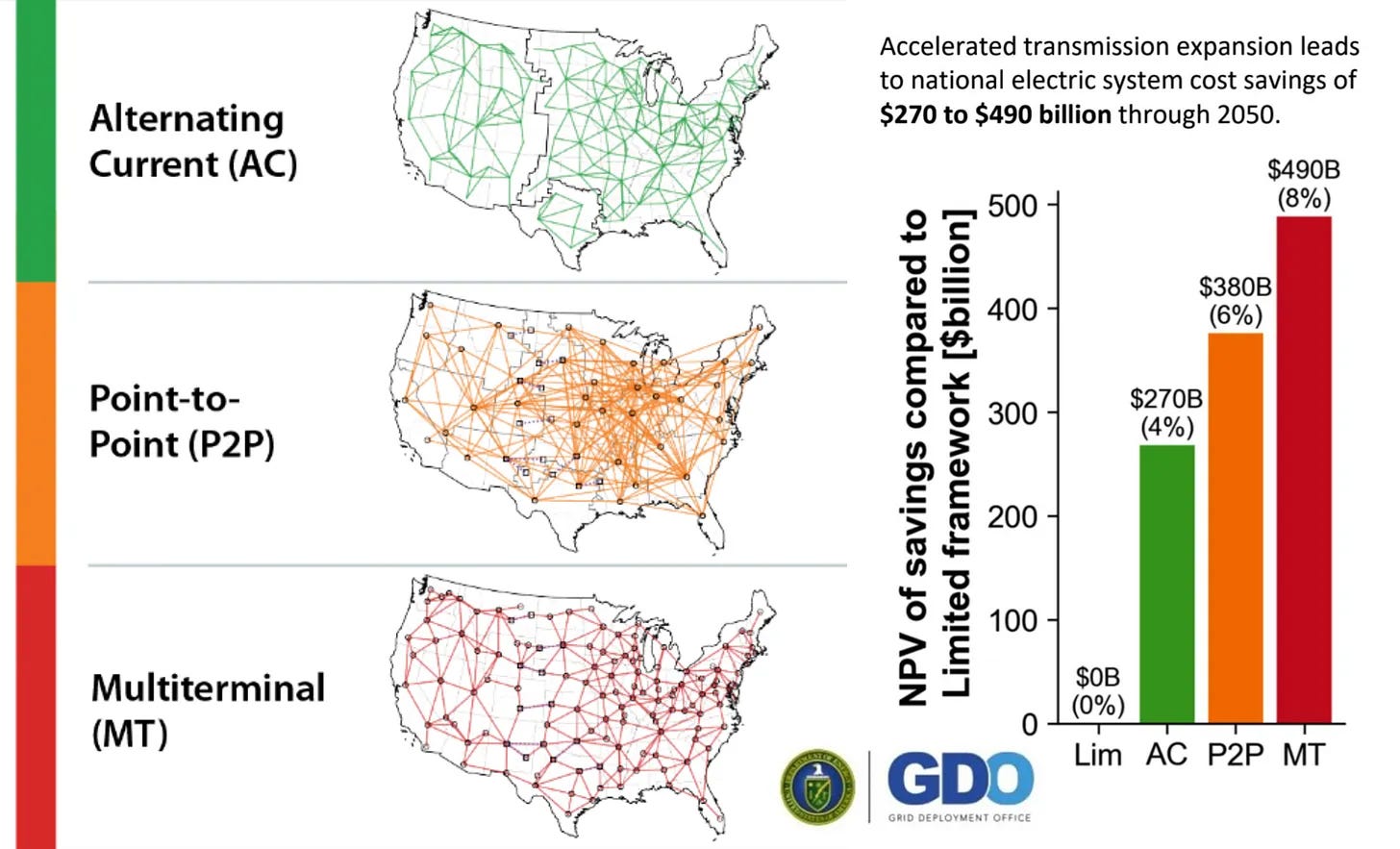
As suggested by the study, transmission lines could provide the backbone upon which electric rail infrastructure could be built. Traditionally, this is most feasible with AC transmission. However, multi-terminal HVDC could offer a more cost-effective alternative. Compared with traditional point-to-point HVDC, multi-terminal HVDC lowers the cost of the on- and off-ramps needed for converting long-distance transmission into power for locomotives. Compared with AC, it offers the advantage of the lower line losses associated with DC transmission.
DOT’s AGCC proposal would add to other recent developments which also promise to lower the cost of electrification. Previous cost estimates for U.S. rail line electrification have been dramatically greater than actual costs in other parts of the world, including the European Union. Several studies have found that one of the reasons for this is that the installation of catenary systems is often coupled with the cost of lifting overpasses, crowning tunnels, and rebuilding bridges. In recent years, a workaround has been identified through the combined use of overhead catenary power where feasible with battery-electric motive power along segments where catenary would be cost-prohibitive—an approach known as discontinuous electrification. The effectiveness of battery electric locomotives is being demonstrated around the world, and U.S. companies Wabtec and Progress Rail are already manufacturing these locomotives.
It is also important to note that the rapid improvement in battery-electric locomotives offers a pathway to the electrification of switcher locomotives in rail yards. This is of particular urgency, as the high geographic concentration of pollution in these areas poses a severe health risk to communities that live near rail yards. Impacts are exacerbated by the fact that the oldest, most polluting locomotives are often used in rail yards, while newer, cleaner ones are employed for line hauls.
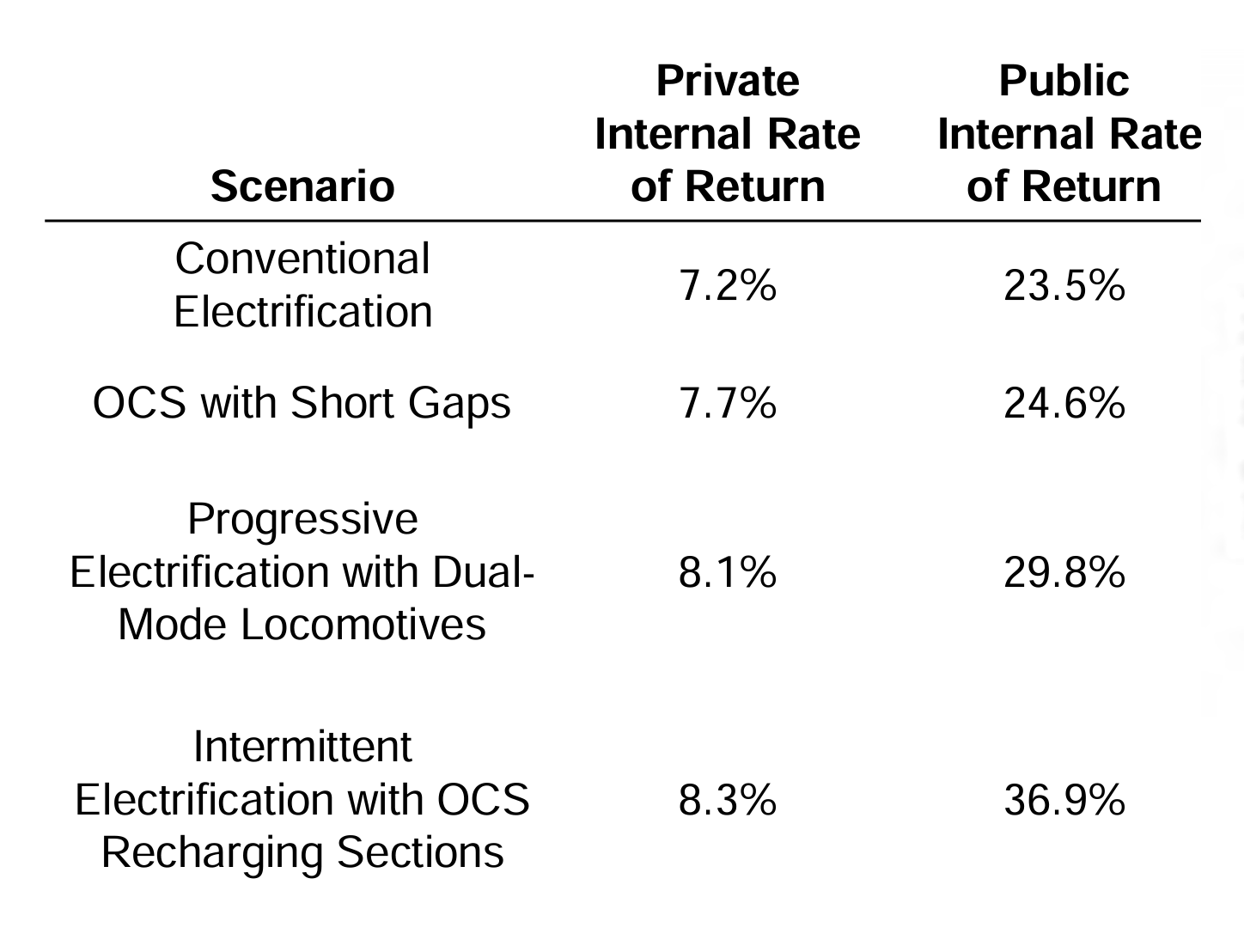
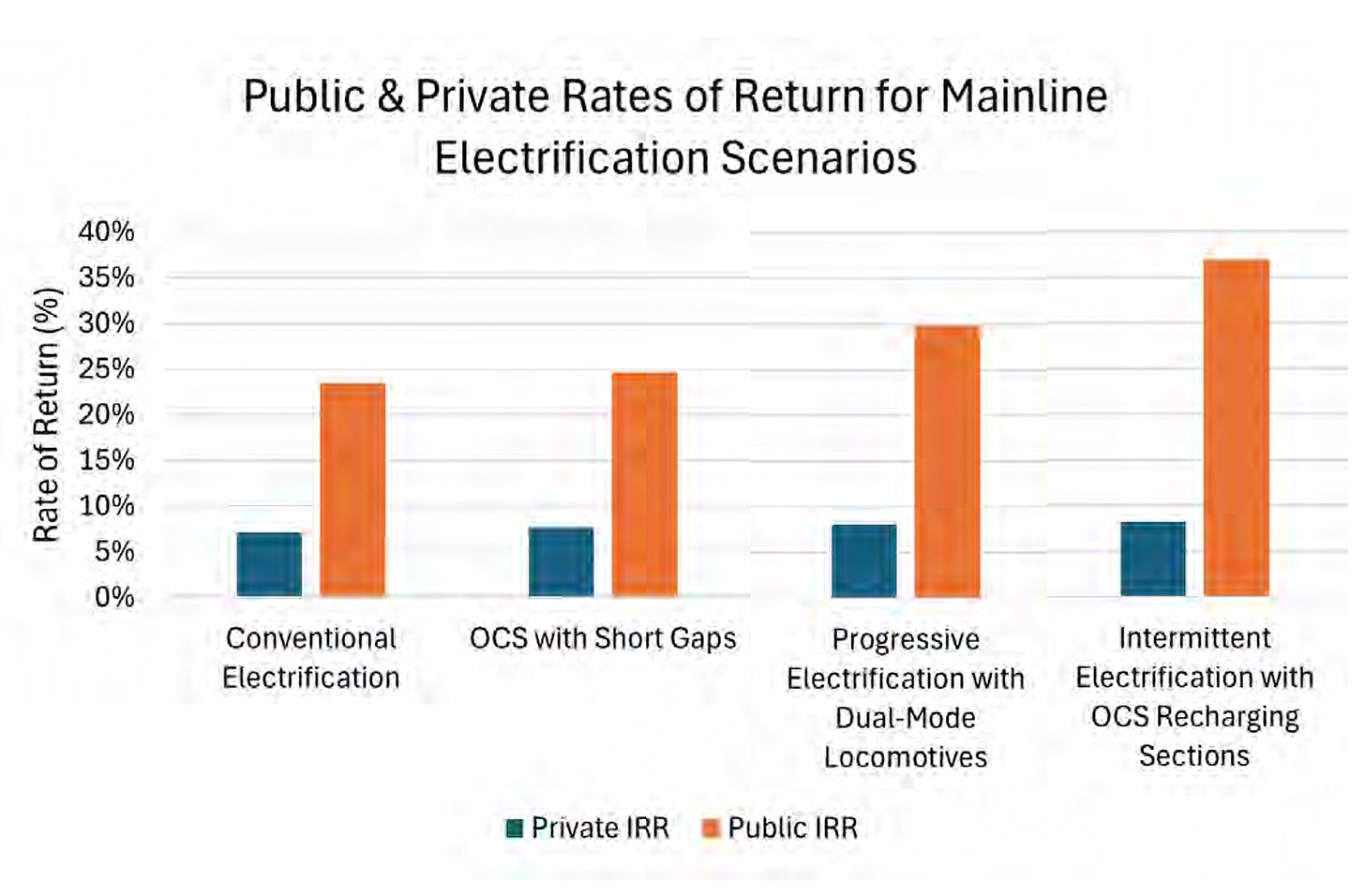
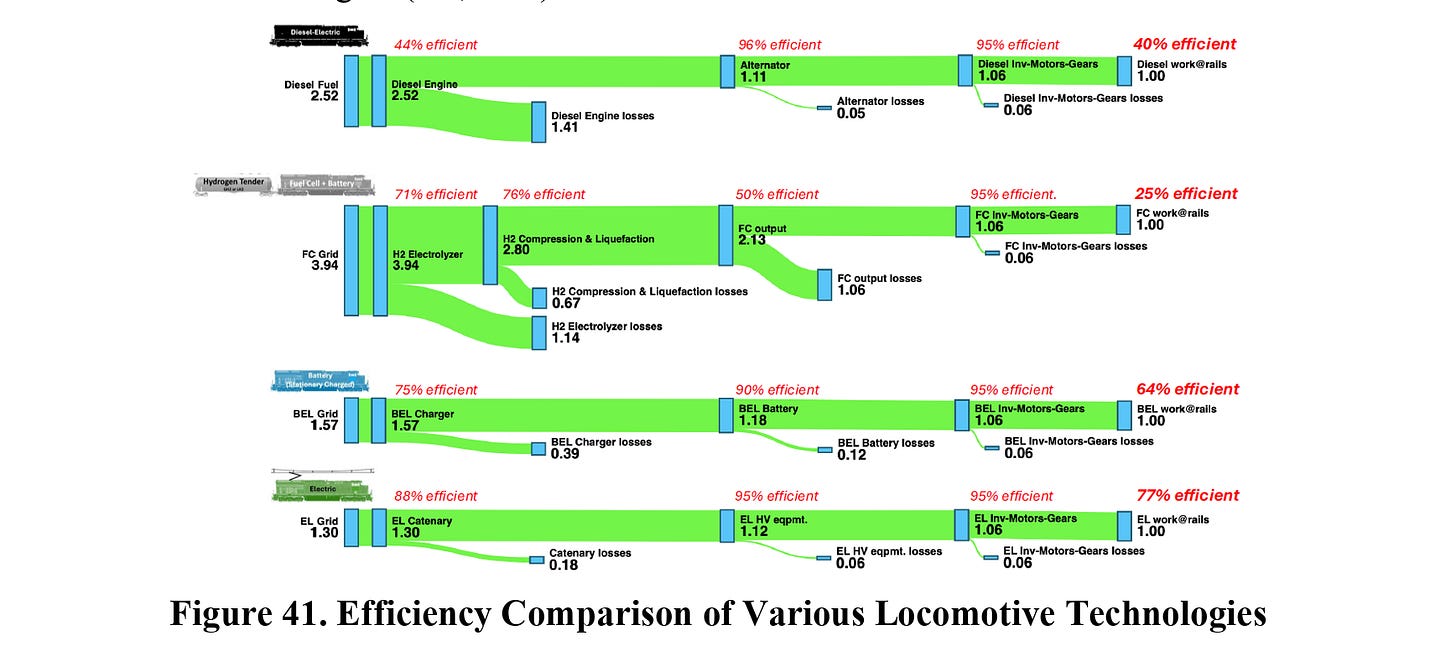
However, as stated above, AGCC offers the greatest potential to lower the cost of electrification on railroads’ main lines, where discontinuous electrification is the optimal approach. The following graphics show the operational efficiencies and cost savings associated with discontinuous (or “intermittent”) electrification, compared with both diesel and other non-diesel approaches to motive power.
Image from slide 29 of a presentation delivered by the authors of the UT Austin study on November 8, 2024 at the University of Illinois at Urbana-Champaign Rail Transportation and Engineering Center’s William W. Hay Railroad Engineering Seminar. The presentation is titled “Modeling the Economics of Modern Options for Mainline Freight Railway Electrification”.
Image from slide 29 of a presentation delivered by the authors of the UT Austin study on November 8, 2024 at the University of Illinois at Urbana-Champaign Rail Transportation and Engineering Center’s William W. Hay Railroad Engineering Seminar. The presentation is titled “Modeling the Economics of Modern Options for Mainline Freight Railway Electrification”.
Image from p.116 of the FRA-sponsored UT Austin study, “Cost and Benefit Risk Framework for Modern Railway Electrification Options”.
Incentivizing Mode Shift of Freight to Rail
The public assistance and facilitation of co-location that AGCC envisions should be designed in a way that produces tangible benefits for the public, not just for private corporations. AGCC could achieve this through a structure that incentivizes a shift of freight onto rail from other modes of transportation that impose greater externalities on the public—especially trucking.
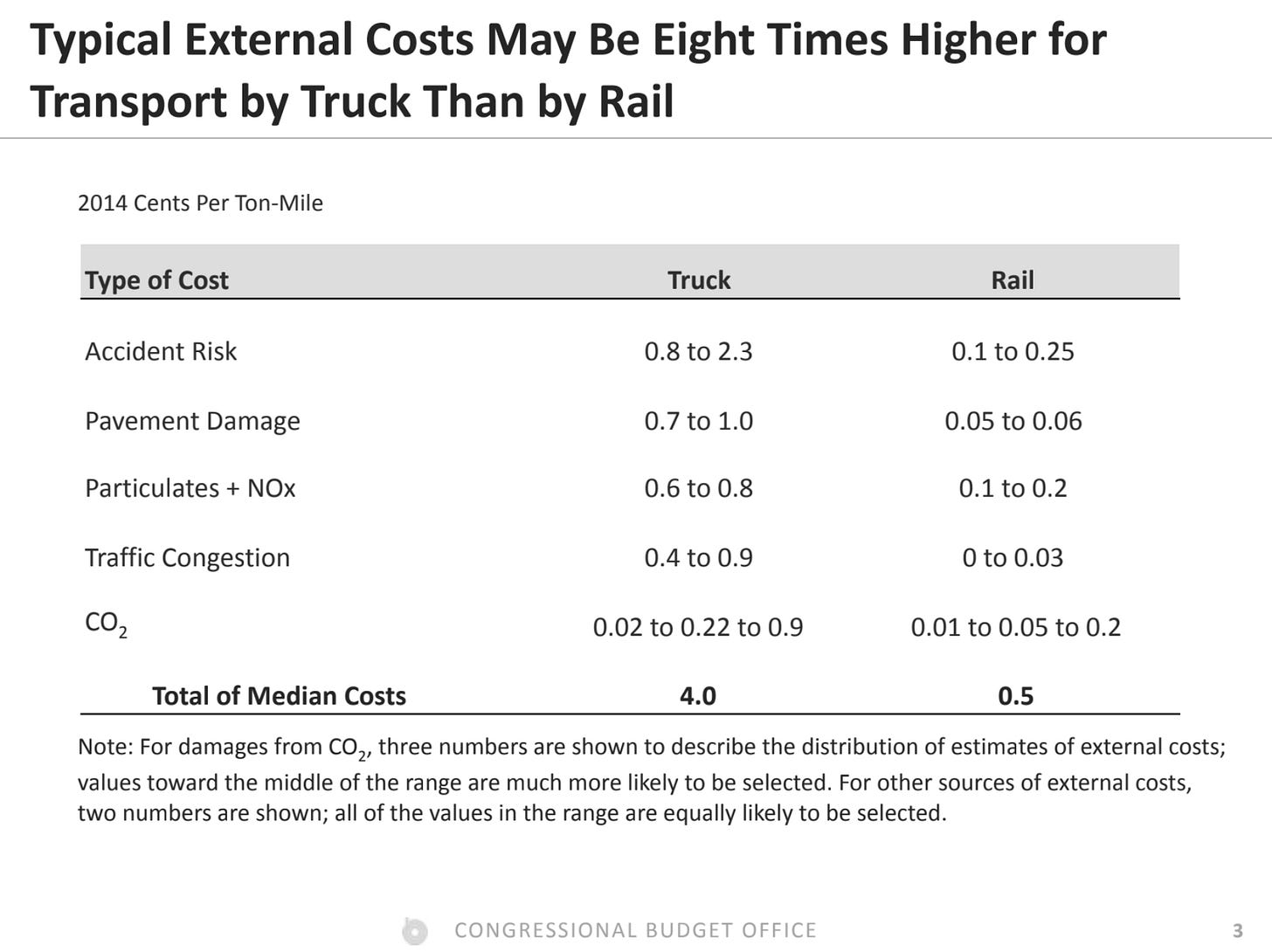
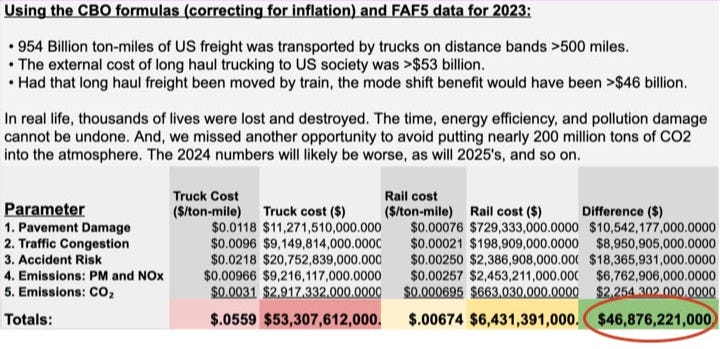
A 2015 Congressional Budget Office (CBO) report found that the external costs per ton-mile of freight moved by truck outnumber external costs when freight is moved by rail by a ratio of 8 to 1. These costs include congestion, air pollution, road wear and tear, accident risks, and greenhouse gas emissions, as shown in the table below. For example, in 2023 trucks carried approximately 954 billion ton-miles of freight on hauls longer than 500 miles. Using the CBO formulas and adjusting for inflation from 2014 to 2023, this amounts to $53.3 billion in annual external costs, compared with $6.4 billion if that freight were to have moved entirely by rail instead of truck. In other words, shifting freight travelling more than 500 miles by truck to rail would have saved nearly $47 billion in external costs that year. Subsequent years have yielded comparable figures in terms of modal share and overall freight ton-miles. Thus, enabling and incentivizing U.S. freight railroads to move a greater share of the nation’s freight delivers multiple public interest dividends.
Image from slide 3 of a presentation delivered on January 3, 2016 by David Austin of the Congressional Budget Office’s Microeconomic Studies Division at the 2016 Allied Social Science Associations Meetings in San Francisco, CA.
Table showing the inflation-adjusted application of CBO’s external cost estimates to freight moving greater than 500 miles on trucks in 2023. Calculations performed using Solutionary Rail’s prototype external cost calculator tool.
AGCC could incentivize a mode shift to rail in various ways. Given that rail line electrification enables operational efficiencies that free up capacity in rail networks, one possibility is for railroad participation in AGCC to be contingent upon rail electrification and, subsequently, upon railroads implementing measures aimed at carrying more freight. The Department could require that railroads use a certain portion of the revenue generated from leasing their ROWs to pay for electrification and for additional measures that result in an increase in rail modal share vis-a-vis trucking. Alternatively—or in addition—electrified railroads could be incentivized to carry more freight by means of discounts offered by the utilities they host on their ROWs. In other words, the cost of electricity for rail operations could be inversely proportional to the amount of freight moved using that electricity. These discounts could be built into the long-term pricing deals that the UT Austin study proposes.
Dedicated Passenger Tracks on Existing Rights-of-Way
A national passenger rail system that offers fast, frequent, and reliable service to Americans throughout the country is also in the public interest. Since the creation of Amtrak in 1970, one of the chief obstacles to speed, frequency, and reliability for passenger trains has been the conflict with freight trains operating on the same tracks—which are owned by the freight rail carriers. Though the so-called “host railroads” have a legal obligation to give priority to passenger trains, as well as to make their tracks available for increased speeds and frequencies of service, these provisions have hardly ever been enforced in the decades since their enactment.
One possible workaround is to construct dedicated passenger tracks on the existing freight-railroad-owned ROWs. Dedicated passenger tracks could be constructed to Class 6 or Class 7 specifications, which allow for speeds of 110 and 125 miles per hour, respectively. In the absence of extremely heavy freight trains, these tracks would have particularly low maintenance costs and a longer lifespan. Just as co-locating transmission on existing ROWs promises substantial savings for utilities, so too does construction of dedicated passenger tracks, capable of high speed, on existing ROWs promise a far more economical alternative to the green-field development of new routes for high-speed rail.
If the freight rail carrier that owns a ROW participating in AGCC declines to electrify their freight tracks, the construction of dedicated passenger tracks offers an alternative means of synergizing transmission with rail electrification. This would, moreover, benefit passenger service and ridership, as demonstrated by the electrification of Northern California’s Caltrain service.
Additional Considerations for Electric Transmission
If the Department has not already done so, Solutionary Rail urges it to consult the Department of Energy’s Grid Deployment Office’s 2024 National Transmission Planning Study. This study illustrates the tremendous promise of expanding long-distance transmission, especially through the use of multi-terminal bidirectional HVDC transmission, which could be buried. The Champlain Hudson Power Express provides an example of the feasibility of buried HVDC along rail rights-of-way.
Engage Stakeholders to Improve Outcomes, Smooth Implementation, and Avoid Conflicts
Solutionary Rail recommends that DOT engages the following stakeholders in further deliberations around AGCC:
Corridor-adjacent communities impacted by diesel emissions concentrated around rail yards and ports.
Corridor-adjacent urban and rural communities and industries with interest in improved freight and passenger rail service.
Tribes with transportation and transmission easements and needs where increased utilization offers opportunity for expanding mutually beneficial partnerships with energy development, infrastructure improvements to protect cultural assets and access, and fulfillment of treaty obligations and economic development goals for service.
Rural electric co-ops who stand to access expanded markets through transmission buildout.
Short line railroads, who stand to strengthen supply chain resilience with increased service to new customers, but who are often constrained by their captivity to a single Class One railroad, as well as by a lack of capital for infrastructure investments.